
Guide · Updated August 2026
Exporting to the grid pays less and less.
Negative electricity prices, Germany’s Solar Peak Act, Austria’s OeMAG floor: the rules for solar surplus are changing fundamentally – in Germany and in Austria. Here is an overview, and what you can actually do. Feed-in tariffs are falling in many other EU countries too; the figures on this page refer to Germany and Austria.
Germany
Zero payment when the sun shines.
For new systems up to 10 kWp with partial grid export, the feed-in tariff is currently around 7.8 cents per kilowatt hour – and still falling; the latest reduction took effect on 1 August.
The real break, however, comes from the Solar Peak Act (Solarspitzengesetz): new systems from 2 kWp with a smart meter no longer receive any payment during hours with negative spot prices. And these hours are increasing: 457 in 2024, already 573 in 2025 – exactly when your system produces the most, the electricity is worth nothing on the exchange. The lost hours are added to the end of the 20-year payment period, but you won’t see that money until the distant future.
The outlook sharpens the picture: for the planned EEG 2027 (Germany’s Renewable Energy Sources Act), scrapping the fixed tariff for new systems under 25 kWp altogether is under discussion, and grid fees for feed-in are being considered from 2029. None of this is final – but the direction is clear.
Austria
OeMAG at its floor.
In Austria, the OeMAG feed-in tariff has fallen to its legal floor – in June 2026 exactly 6.772 cents per kilowatt hour (60% of the quarterly market price minus balancing energy). Without this floor, the tariff would be even lower, because spot prices during sunny hours have collapsed. The industry expects up to 800 hours with negative prices in 2026.
At the same time, grid electricity costs around 22 to 30 cents, depending on tariff and grid area. And because grid fees are increasingly based on peak demand, pushing energy through the grid uncontrolled is becoming even more expensive.
The most valuable kilowatt hour is the one your house keeps – worth around three to four times as much as one you export.
Your options
Your three levers.
All three work together – and all three come down to keeping the surplus in your home instead of giving it away for almost nothing.
Maximise self-consumption
Battery, hot water, electric car, heat pump – every kilowatt hour that stays in the house saves expensive grid electricity. Which building block brings how much, and where each one reaches its limit, is set out in the comparison.
Control grid export by spot price
If you control by spot price, you don’t export during negative-price hours – you shift consumption to exactly those hours. That requires a controller that considers electricity price, solar production and consumers together – it can’t be done by hand. On the miner side, the MINEOMATBOX comes with this price logic built in.
Find a use for the leftover surplus
Even when the battery is full and the water is hot, there is still surplus on good days – exactly the kind that will hardly earn any money in future. A Bitcoin miner connected to a miner controller takes up this remainder – the way you have set it up.
Important for lever three: surplus does not automatically become Bitcoin. If the spot price is high enough, the controller pauses the miners and exports to the grid. You set the rule, the box carries it out. Whether this pays off for your system is shown by the counter-calculation in the guide Bitcoin mining with solar surplus.
The matching controller
A home for the leftover surplus.
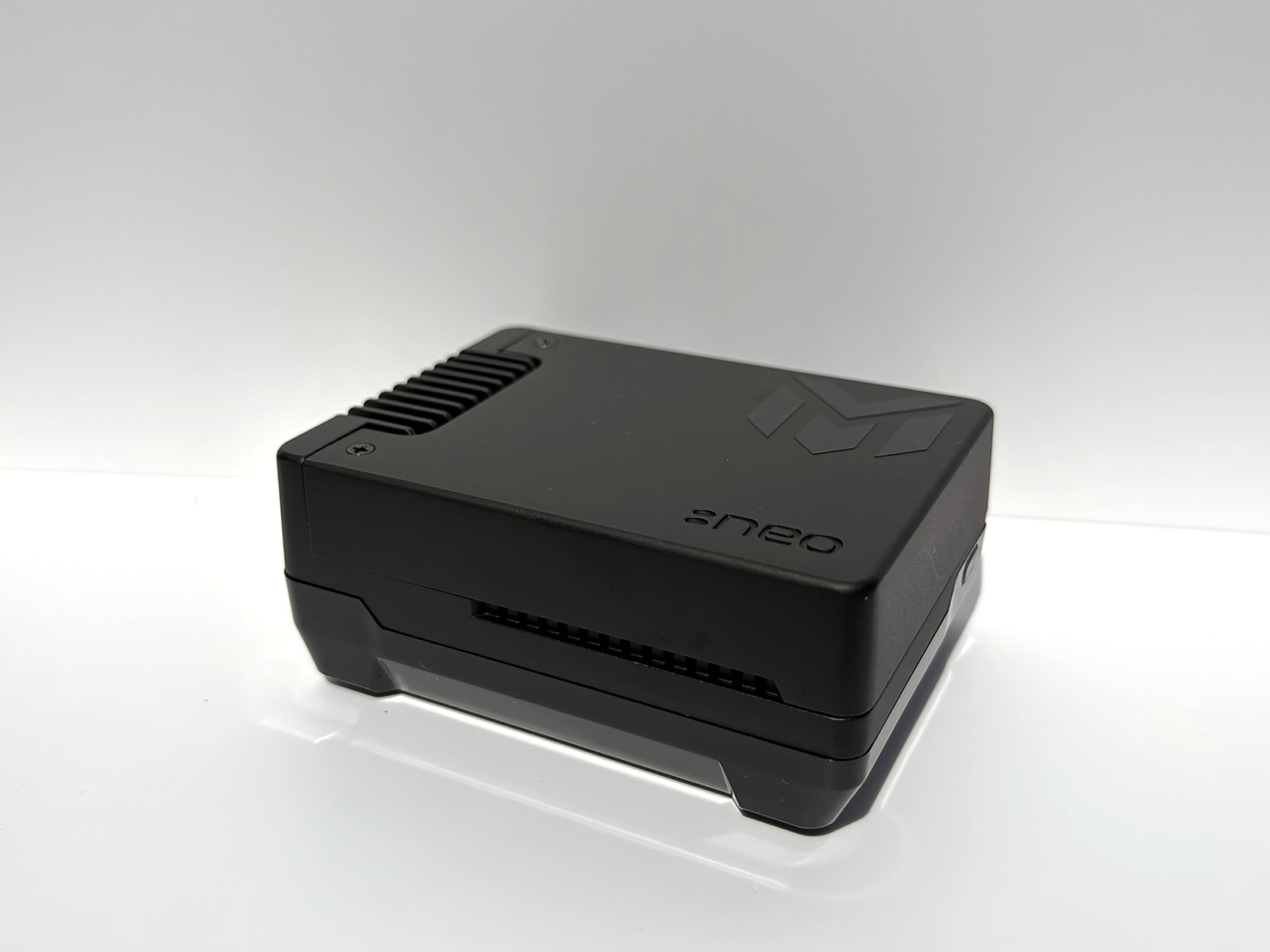
A controllable consumer for exactly this remainder: the MINEOMATBOX regulates your miners according to surplus, spot price and your thresholds – locally in your home on Home Assistant, with no cloud and no subscription.
MINEOMATBOX HOME · €499
up to 8 miners · incl. VAT, plus shipping
To get started: MINEOMATBOX MINI for €299 (2 miners).